In this guide
For most train journeys within Switzerland, you do not need to reserve a seat.
That is one of the things that can feel unusual if you are visiting from a country where long-distance train travel normally means choosing a specific train and seat in advance.
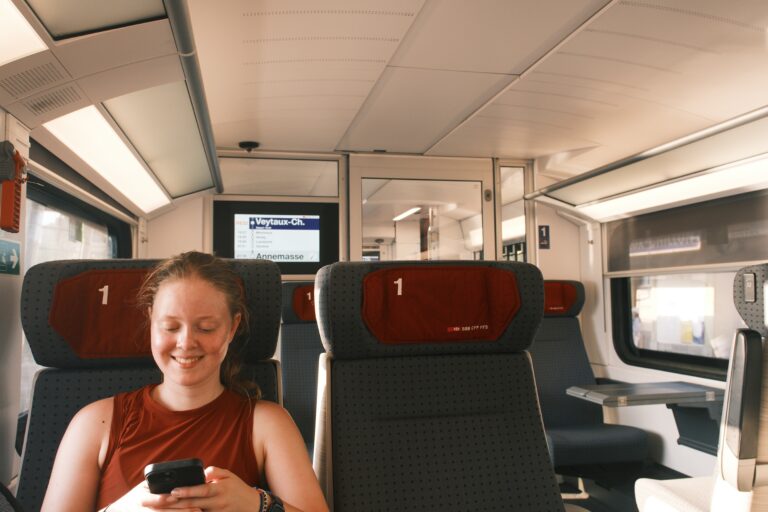
In Switzerland, I usually just choose the connection I want, board the train and find an available seat.
That works for the vast majority of the normal train journeys I make around the country.
There are exceptions, particularly some panoramic and international trains, but for a typical trip between places such as Zurich, Lucerne, Interlaken, Lausanne or many destinations in the Jungfrau region, I would not assume that you need a seat reservation.
Quick answer
| Train or situation | Seat reservation? |
|---|---|
| Normal Swiss regional train | Usually not needed |
| InterRegio train | Usually not needed |
| Swiss InterCity | Optional on reservable services |
| Busy normal Swiss train | Optional if available |
| Glacier Express | Reservation required |
| Bernina Express | Reservation required on the panoramic service |
| Gotthard Panorama Express | Reservation required on the relevant panoramic service |
| Some other tourist trains | Check the specific service |
| TGV to/from France | Required |
| Long-distance trains to Italy | Generally required |
| Train to Germany/Austria | Depends on the service; often optional |
The easiest rule is:
Do not automatically reserve normal Swiss trains. Check separately when taking a panoramic or international service.
SBB marks trains where reservations are available with an R in the timetable, while services where a reservation is compulsory are marked accordingly.
How normal Swiss trains work
For normal train travel within Switzerland, you generally buy the ticket or use your valid travel pass and then take the connection you want.
You do not normally have a seat assigned to you.
Instead, you board and choose an available seat.
That makes train travel quite flexible.
If your plans change or you decide to take another suitable connection, you are not necessarily tied to a particular seat reservation in the way you might be on some European high-speed trains.
The exact ticket conditions still matter — particularly with discounted tickets — but the seat itself is usually not the restrictive part.
That distinction is useful:
your ticket and your seat reservation are two different things.
Can you reserve a seat on a Swiss InterCity train?
Yes.
SBB currently allows seat reservations on reservable Swiss InterCity services. A reservation costs CHF 5 per seat and can be booked through SBB’s website or app, among other channels.
But being able to reserve a seat does not mean that I think every tourist should.
For ordinary travel, I normally would not bother.
The flexibility of simply boarding and finding a seat is one of the things I like about travelling by train in Switzerland.
A reservation can become more useful when:
- you are travelling as a larger group;
- sitting together matters;
- you are travelling at a particularly busy time;
- you have a long journey and strongly prefer a specific seat;
- you want a family, quiet or other reservable area where available.
For a couple travelling around Switzerland on a normal itinerary, I would usually keep things simple.
I normally don’t reserve seats
For the normal Swiss train journeys I take, seat reservations are not something I usually plan around.
I have travelled throughout Switzerland by train without feeling that every journey needs to be booked down to a specific seat.
That includes the type of routes tourists commonly use when travelling without a car.
I prefer being able to choose a connection and board it without making every travel day more complicated than necessary.
That flexibility becomes particularly useful if you are travelling around rather than commuting on exactly the same train each day.
If you finish lunch earlier, spend longer at a viewpoint or simply change your plans, public transport should make the trip easier rather than become another rigid part of the itinerary.
What if the train is busy?
A train not requiring reservations does not guarantee that you will always find the perfect empty row.
Popular services can be busy.
You may sometimes have to sit apart from your travel companion or look through a few coaches for available seats.
Personally, I would still not automatically reserve every normal Swiss train because of that possibility.
If I knew I was travelling during an unusually busy period and sitting together was important, I might consider a reservation on a service where SBB offers one.
Otherwise I would simply board and look for available seats.
First class can make this easier
If you are already travelling first class, finding space is often easier.
That has also been my experience when travelling with luggage.
There is generally more personal space, which makes longer journeys more comfortable.
Again, I would not buy a first-class ticket solely because I was afraid I might not find a seat.
But if you already value the extra comfort, reduced crowding can be another benefit.
Travelling with bags: Seat reservations and luggage are two of the biggest concerns for first-time train travellers. My Switzerland by train with luggage explains what carrying bags on Swiss trains is actually like.
When seat reservations are different: panoramic trains
This is where visitors need to pay more attention.
Some of Switzerland’s famous panoramic trains do not work exactly like an ordinary regional service.
SBB specifically lists services such as the Bernina Express, Gotthard Panorama Express and Glacier Express among tourist trains where reservation rules apply.
So if you are booking a named panoramic train, do not assume that the normal Swiss free-seating approach applies.
Check the exact service before travelling.
This distinction matters because sometimes there are also normal trains over similar routes.
The reservation requirement may apply to the dedicated panoramic service rather than every train travelling through the same landscape.
That is why I always look at the actual train in the timetable rather than assuming that an entire route requires reservations.
Glacier Express
The Glacier Express is one of the clearest examples.
A seat reservation is required for the dedicated Glacier Express service.
Your rail pass or ticket and your seat reservation are separate parts of the journey.
So having a Swiss Travel Pass does not automatically mean that you can simply walk onto the Glacier Express and choose a seat.
This is exactly the kind of exception that causes confusion for first-time visitors.
Bernina Express
The dedicated Bernina Express panoramic service also has mandatory reservation requirements.
Again, that does not mean that every ordinary train running in the Bernina region operates with compulsory seat reservations.
The specific service matters.
If your goal is simply to travel through the landscape rather than specifically experience the panoramic train, it can therefore be worth looking at ordinary connections as well.
Gotthard Panorama Express
The Gotthard Panorama Express also has a compulsory seat reservation on the relevant panoramic rail section.
SBB treats these tourist trains separately from ordinary Swiss InterCity travel.
This is why I would not use one blanket rule such as:
You never need reservations in Switzerland.
For most normal journeys, that is close to how it feels in practice.
For specific tourist services, it can be wrong.
What about the GoldenPass Express?
The GoldenPass Express is another service where I would check the exact reservation conditions for your chosen journey rather than relying on the general rules for normal Swiss trains.
The important distinction is the same:
named panoramic services deserve an extra check.
If you are travelling between Interlaken and Montreux, this becomes particularly relevant because you may be comparing a dedicated panoramic experience with ordinary public-transport connections.
Do you need seat reservations with a Swiss Travel Pass?
Usually not for normal Swiss trains.
A Swiss Travel Pass acts as your transport entitlement on services covered by the pass; it does not mean that every train suddenly requires an additional reservation.
On normal Swiss trains without compulsory reservations, you can generally travel with the valid pass and take an available seat.
But if the specific train requires a reservation — for example certain panoramic services — the pass does not remove that requirement.
The same basic distinction applies to other rail passes:
ticket/pass = permission to travel
seat reservation = claim to a specific seat
Sometimes you need both.
Usually on normal Swiss public transport, you do not.
Do you need reservations between Zurich and Interlaken?
For ordinary domestic Swiss connections between Zurich and Interlaken, I would not normally reserve a seat.
I would choose the connection I wanted and travel normally.
If you are planning that route, see my Zurich to Interlaken train guide.
The more important things to understand are the route, transfers and which Interlaken station you need.
Interlaken to Lauterbrunnen
You also do not need to think about seat reservations as a major part of the ordinary journey from Interlaken into Lauterbrunnen.
This is normal regional public transport rather than a reserved-seat high-speed experience.
See my Interlaken to Lauterbrunnen train guide for the actual journey.
Interlaken to Grindelwald
The same principle applies when travelling towards Grindelwald.
I would focus on taking the correct connection rather than trying to reserve a particular seat.
My Interlaken to Grindelwald train guide explains the route.
What about international trains?
International journeys are where the rules become less uniform.
SBB currently states that seat reservations are compulsory for TGV services to France and for connections to Italy where reservation is included with the relevant ticket. For Germany and Austria, reservations are generally not compulsory but SBB recommends them.
So once your train crosses the Swiss border, do not automatically apply Swiss domestic habits.
Check the specific service.
This matters especially for travellers combining Switzerland with:
- Paris;
- Milan;
- Germany;
- Austria;
- other European rail trips.
Do I need to book Swiss trains in advance?
This is a slightly different question from seat reservations.
A traveller can buy a ticket in advance without reserving a seat.
Likewise, certain tickets may have specific train or timing conditions even when there is no assigned seat.
So when planning a Switzerland trip, separate these questions:
1. Do I need a valid ticket?
Obviously yes.
2. Does my ticket restrict which train I can use?
Depends on the ticket.
3. Do I need to reserve a seat?
Usually no for normal Swiss domestic trains.
This distinction makes the entire system much easier to understand.
How do you know whether a reservation is required?
Use the timetable information.
SBB states that reservable trains are indicated with an R, while an R combined with the relevant seated-person symbol indicates a compulsory reservation.
That is much safer than relying on a generic online list that might become outdated.
Before taking a special panoramic or international service, check the actual journey in SBB.
Rules can also differ between services that appear similar.
Can you reserve a seat in the SBB app?
Yes.
For eligible Swiss InterCity trains, SBB allows reservations through SBB Mobile.
You can book the reservation together with a ticket or choose a reservation-only option, and on eligible domestic InterCity trains you can select the seat using the coach plan.
I would use this when I had a specific reason to reserve rather than treating it as a required step for every train journey.
Do families need to reserve seats?
Not necessarily.
But families are one group where an optional reservation can make more practical sense.
If you have several children and want to guarantee that everyone sits together, reserving seats on an eligible service may remove some uncertainty.
SBB also allows reservations in eligible family coaches on services where they are available.
For a solo traveller or couple, the benefit is usually smaller.
What about groups?
This is another exception.
For groups of 10 or more people, SBB has separate group reservation rules.
So this guide is mainly aimed at the typical independent traveller, couple, family or small group.
If you are organising a large group trip, check SBB’s specific group guidance.
What happens if your reserved train changes?
A reservation does not make train operations completely predictable.
SBB notes that a seat reservation can lose its validity if the rolling stock changes at short notice.
That is another reason I do not see reservations as something ordinary tourists should obsess over on every domestic journey.
They can provide extra certainty, but they are not the foundation of normal Swiss train travel.
My recommendation for first-time visitors
For an ordinary car-free trip around Switzerland, I would keep this simple:
Do not spend your trip trying to reserve every Swiss train.
For normal domestic trains, buy or activate the correct travel entitlement, choose the connection you want and find an available seat.
Then pay extra attention when you see:
- a dedicated panoramic train;
- an international high-speed train;
- a service explicitly marked as reservation compulsory;
- a large group journey.
That covers most of the situations where the rules change.
Switzerland’s public transport works so well partly because normal journeys do not need to feel like airline bookings.
You should be able to decide where you are going, check the timetable and get on the train.
For most of my own travel around Switzerland, that is exactly what I do.
Frequently asked questions